The Madison Club sits at the southern edge of La Quinta, off Madison Street, on land that was previously raw desert and scattered citrus groves. From the outside it looks like every other gated community in the southern half of the city — a long perimeter wall, a discreet entry gate, mature landscaping pushing up against the curb. The street name is not announced. There is no sign on the highway. That understatement is the first signal of what the community is trying to be.
From the inside, it is one of the most architecturally consistent private golf communities in the Coachella Valley.
The course
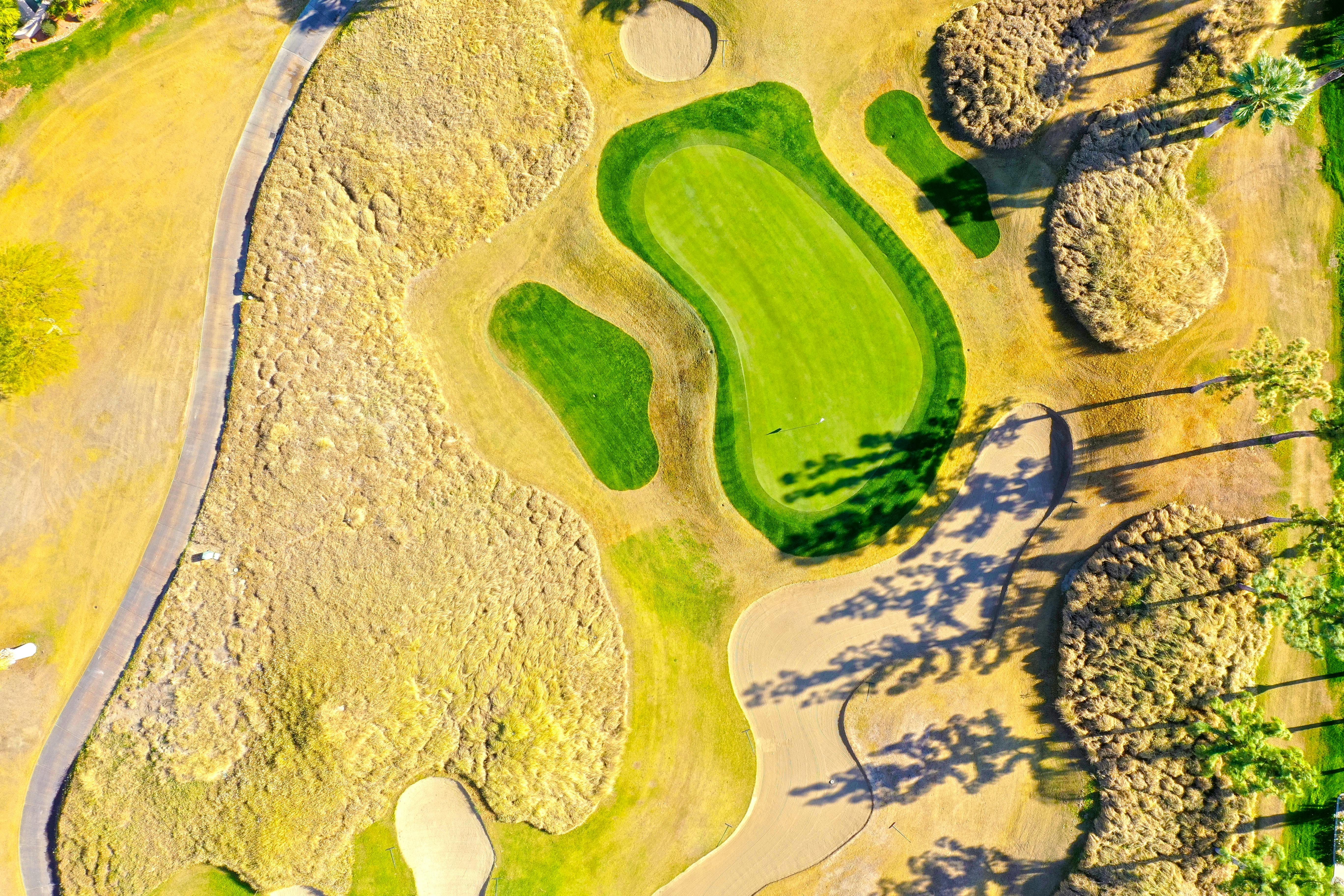
Tom Fazio routed the course in the mid-2000s, working from a flat, irrigated plain pushed up against the Santa Rosa Mountains to the south and looking back toward the Coral Reef range to the north. The routing prioritizes broad fairways, generous lake margins, and a deliberate sequence of view reveals: most holes hold their best mountain view for the second shot rather than the tee.
This is consistent with Fazio\u2019s broader design philosophy. He has spoken publicly for decades about wanting member golfers to enjoy the experience repeatedly — the heroic single-round shot is less interesting to him than a course that holds up across a hundred plays a season. At Madison, the result is a course that can be stretched over 7,200 yards from the back markers and that plays comfortably under 6,400 from a member-friendly box. Few houses see significant penalty for a normal mis-hit; recovery from the rough is usually playable.
Conditioning is consistently strong. The combination of a small membership, no resort play, and a robust agronomy budget produces a course that visiting professionals routinely cite as one of the best-maintained in the valley. The grass program is overseeded for winter play and the transition periods are managed carefully — an important consideration for a membership that skews seasonal.
What the course is not: a tournament venue. Madison was not designed to host televised professional events, and the routing makes no concession to spectator galleries, broadcast tower sight lines, or the kind of difficulty profile that PGA Tour setups demand. The PGA West Stadium course is fifteen minutes away if that is the kind of golf you want. Madison is something else.
Membership and access
Madison Club membership is equity and historically by invitation. The club does not market itself publicly in the way larger Coachella Valley operations do. The membership roster is not published. There is no listed phone number for membership inquiries.
We deliberately do not publish a current initiation figure here. Those numbers move, and we have not independently verified the current standard. What is reliably understood: Madison sits at the high end of La Quinta private-club entry costs, and anyone considering joining should expect to be sponsored by an existing member and to go through a vetting process. Day-play access for non-members is essentially non-existent; this is a member-and-guest operation.
The practical effect of the small cap is what you would expect. Tee sheets are not pressured. The dining room is not pressured. The driving range does not run out of stations. The character of the social calendar is more intimate than at the larger La Quinta clubs — small dinners, member-hosted gatherings, a quieter version of the desert season.
The real estate
Lot sizes at The Madison Club are large by Coachella Valley standards. The community is built around full acre and half-acre parcels in the original phases, with several estate-scale lots along the southern boundary that push beyond. There is no condo stock, no fairway villa product, and very little inventory under 4,000 square feet.
The architectural language is dominated by contemporary California and modern Spanish-Mediterranean. Most homes were designed by established Coachella Valley architects and built since the mid-2000s, with a steady stream of teardown-and-rebuild activity as the original first-generation homes turn over. The community design code controls building heights, exterior palette, massing, and landscape vocabulary. The result is a streetscape that reads as a single coherent design idea from the curb — one of the visual qualities that separates Madison from older La Quinta communities where the architectural era of each home is more visible.
Buyer profile is overwhelmingly seasonal. Most owners maintain primary residences in coastal California (Los Angeles, San Francisco Peninsula, Orange County), in the Bay Area, or out of state. The community is materially quieter in the summer months — a feature for many buyers, who use Madison specifically as a winter-and-shoulder-season home, and a drawback for buyers looking for a year-round community with consistent activity.
Inventory turns slowly. In a typical year a low single-digit number of homes change hands across the community, with off-market activity adding to that number quietly. The market is highly information-asymmetric — comps are limited, and buyers without a knowledgeable agent partner often have difficulty modeling current value with confidence.
How it compares within La Quinta
Within La Quinta, The Madison Club is most often compared to The Quarry at La Quinta (also Fazio, smaller, more vertical) and to The Hideaway (Pete Dye and Clive Clark, mid-size, 36 holes).
The Madison vs Quarry comparison is the most instructive. Same architect, very different idioms. Quarry is built on a former rock quarry and uses the surviving rock walls and dramatic elevation changes as its visual signature — narrower corridors, more variable shot demands, a course you remember by its topography. Madison is built on flat ground and uses the mountains as its frame — wider corridors, more uniform shot demands, a course you remember by the second-shot reveals. Both are excellent. They are not interchangeable.
The Madison vs Hideaway comparison is mostly about scale. Hideaway has two courses (Dye and Clark) and a larger membership; Madison has one course and a smaller membership. Hideaway has more active golfers per acre; Madison has more privacy per acre. Either way, the two clubs are typically the short list for a buyer who wants a newer-construction private community in La Quinta with strong architectural cohesion.
Madison vs PGA West is the most important comparison for a first-time La Quinta buyer to understand. PGA West has six courses, multiple membership tiers, daily-fee resort access, a PGA Tour event on the calendar, and inventory from one-bedroom condos to multi-million-dollar estates. Madison has none of that. The two communities exist on completely different operational scales, and the appropriate choice depends entirely on whether you want operational scale or you want privacy. Both are legitimate answers.
What we will not tell you
We will not publish a current initiation figure for The Madison Club. We will not publish median home prices, average days-on-market, or the names of specific homeowners. We will not name pros or celebrities reputed to own at Madison — the Coachella Valley has a long history of celebrity ownership and their addresses are not editorial subjects. Anyone making these claims on a competing site without sources is making them up.
What we will tell you, confidently: Madison is an story about architectural restraint, about a small private-club model that has held up while many larger ones have churned, and about the part of La Quinta that goes quietest in the summer and busiest in March. Whether that matches what you want from a desert second home is a question only you can answer.
If you are seriously considering The Madison Club, work with a California-licensed agent who has closed inside the community within the last two seasons. Ask for off-market activity context. Ask the club directly about current membership status. Verify every figure you read — including the ones in our other articles — against a licensed source before you transact.
How tee times actually work
A practical note on the daily rhythm. Because Madison is member-and-guest only and the membership cap is small, the tee-sheet experience differs materially from PGA West or even from the Hideaway. A member can typically book a Saturday morning round inside a week of play without difficulty. Walk-on play for member guests is generally accommodated. Cart and caddie programs operate to a standard you would expect at a top-tier private club; pace of play is consistently under four hours in the peak season, which is rare at Coachella Valley resort properties.
The practical implication for a prospective buyer evaluating Madison: do not assume the small membership means limited access. The smaller cap is precisely what produces the more accessible tee-sheet experience. The trade-off is initiation cost and the time commitment of the membership process, not day-to-day availability.
The architecture code, in detail
The community design code at The Madison Club is enforced more strictly than at any other La Quinta private. Height limits cap most homes at single-story or a modest single-story-plus-loft profile. Exterior palettes are restricted to a narrow range of warm desert tones (limestone, sand, white-cement, terracotta accents) with formal review of any new build or substantial remodel. Landscape architecture is similarly governed: a defined palette of palms, agaves, native grasses, and approved flowering species; no turf in front yards beyond what the original design intent allowed.
The result is a streetscape that reads as a single coherent piece of architecture, with very little of the era-mix-and-match you see in older La Quinta neighborhoods. For buyers who care about resale insulation against trend cycles, the consistency is a real asset. For buyers who want the freedom to build a contemporary glass-and-steel modern in a more eclectic neighborhood, Madison is the wrong fit.
A typical season
The rhythm of a Madison Club season tracks the broader Coachella Valley calendar but is quieter on both ends. October through mid-November is the slow ramp — the membership is back in residence but the social calendar has not yet thickened. Mid-November through mid-March is the high season: full dining service, member tournaments, charity events, the Stagecoach and Coachella music festivals pulling a different crowd through the broader valley while Madison stays quiet behind its gate. Late March and April taper down. May through September the community is largely empty — clubhouse operations reduce, several restaurants close, and the course goes into its overseed transition.
This seasonality is the single most important practical fact about The Madison Club. A buyer expecting a year-round amenity experience will be disappointed. A buyer expecting a deep, social, winter-active community with quiet summers will get exactly what the community is designed to deliver.
The Madison vs Quarry deeper read
Within the Fazio Coachella Valley catalog, the most instructive direct comparison is Madison Club versus Tom Fazio\u2019s other La Quinta routing, The Quarry at La Quinta. Both are Fazio. Both are private equity. Both sit at the top of the La Quinta price band. They function very differently.
The Madison routing is built on flat ground and uses lateral width and view-corridor reveals as the dominant shaping technique. The Quarry routing is built around the surviving rock walls of the former quarry site and uses vertical drama as its signature. Madison\u2019s second-shot reveals tend to be the framed mountain backdrop; the Quarry\u2019s second-shot reveals tend to be the topographic punch of a hole dropping or rising through the quarry walls.
For a member, the practical difference is shot variety. Madison gives you a more uniform shot diet across a round; the Quarry gives you a more variable one. Some players find the Quarry tiring on repeat play because of the elevation work; some find Madison repetitive precisely because it does not. Neither response is wrong, and both are useful information about whether the Fazio idiom you actually want is the wide-and-framed version or the narrow-and-vertical version.
Real-estate footprint follows a similar pattern. Madison\u2019s lot count is larger; the Quarry\u2019s is smaller. Per-lot value is comparable at the top of the band but the inventory turnover patterns are different. The Quarry\u2019s smaller membership means lower year-on-year transaction count, which compresses comp data even further than Madison\u2019s already-thin comp pool.
What to look for on the first walk-through
If you are visiting The Madison Club for the first time as a prospective buyer, three specific things deserve attention.
First, the streetscape consistency. Walk a representative block. Look at the height profile, the exterior palette, the landscape architecture. If the streetscape reads as a single coherent design idea from the curb, that is the community design code working. If it reads inconsistent, you are walking an older neighborhood; Madison is not that neighborhood. (Some prospective buyers visit other La Quinta clubs first and arrive at Madison expecting the same level of architectural mix, then are surprised by the consistency. It is intentional.)
Second, the clubhouse rhythm at midday. The dining room at lunch tells you more about the social character of a club than any brochure. Madison\u2019s lunch service is reliably present but quiet. Members tend to know each other. There is no resort-driven foot traffic. If the energy you saw on your visit looked low, that is the steady-state; it does not get materially louder.
Third, the practice facility. Madison\u2019s practice areas reflect the small membership: rarely crowded, well-conditioned, with the kind of access that makes serious game improvement realistic. For a buyer for whom the practice facility matters, this is a meaningful distinguisher from the larger La Quinta operations.
The honest summary
The Madison Club is a precise answer to a specific buyer profile: someone who wants a contemporary California estate in La Quinta, prefers Fazio-style course architecture, values architectural consistency in the surrounding streetscape, prioritizes privacy over operational scale, and is comfortable with the seasonal rhythm of a quiet-summer community. For that buyer, Madison is among the strongest answers in the Coachella Valley.
For any other buyer profile, one of the other six La Quinta clubs is probably the better fit, and we cover those in their own profiles. The most common mismatches: buyers who want a more active year-round community land happier at La Quinta Country Club; buyers who want operational scale and a Tour event land happier at PGA West; buyers who want the same architectural philosophy with more vertical drama land happier at The Quarry.
Estimate only — verify with a licensed California real-estate professional before transacting.